
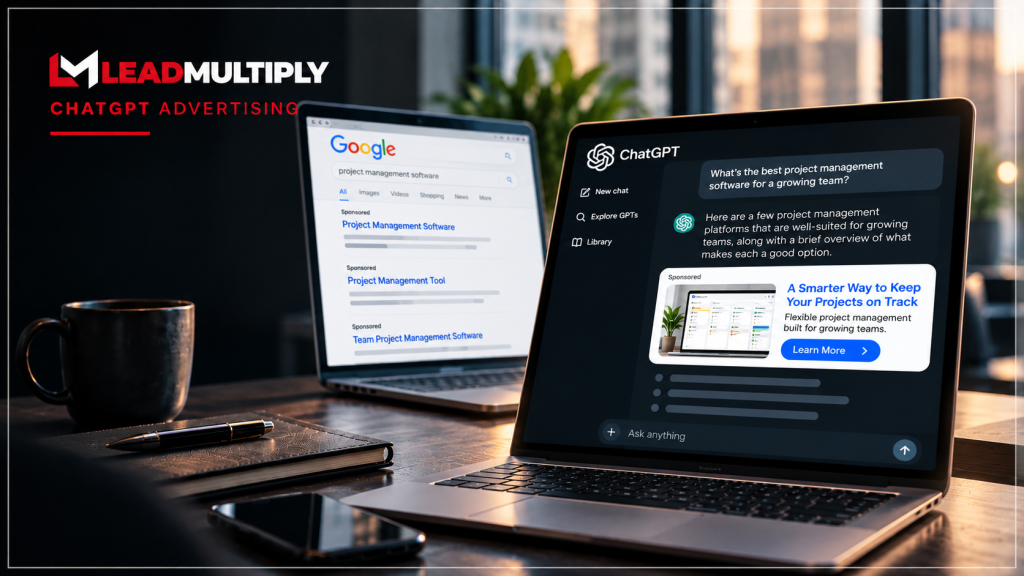
Businesses considering ChatGPT advertising may be tempted to approach it the same way they approached other digital advertising channels: take what is already working, adapt the format and begin running ads. One of the first large-scale studies of ChatGPT advertising suggests that approach could miss much of what makes the channel different. Research from Graphite and Similarweb analyzed more than 98,000 ChatGPT ads and 8,000 landing pages, including more than 95,000 U.S. ads from over 500 advertisers. Among the most significant findings, leading advertisers created 98% new ad copy for ChatGPT rather than reusing advertising from other channels. That is a strong indication that companies actively testing ChatGPT Ads aren’t treating them as another placement for campaigns originally built for Google or Meta.
The distinction matters because the customer interaction surrounding the advertising is different. Search advertising generally begins with a query that a potential customer has reduced to a handful of words. ChatGPT can contain considerably more information about the problem, the circumstances surrounding it, the alternatives being considered and what the person is ultimately trying to accomplish. That changes what an advertiser can know about the customer’s intent, how an advertising message can address it and what should happen after the customer clicks.
Google Starts With a Search. ChatGPT Can Start With a Conversation.
Traditional search advertising generally reaches a potential customer after that person has condensed a need into a search query. The query may communicate considerable buying intent, particularly when someone searches for a specific product, service or company, but it still represents a relatively short expression of what the person wants. Much of the context behind the search remains unknown. The advertiser may know what someone typed, but not necessarily why the person needs it, what has already been considered, which concerns are most important or what could ultimately determine the purchase.
ChatGPT changes that dynamic because the commercial opportunity can develop over the course of a conversation. A person can begin with a problem rather than a product, ask follow-up questions, compare possible approaches, introduce new requirements, reject alternatives and gradually narrow the decision. By the time advertising becomes relevant, the conversation can contain a much richer expression of intent than a conventional search query. The customer may not have entered ChatGPT intending to find a particular company at all, yet the conversation can lead directly toward a product or service capable of solving the problem being discussed.
That creates an important difference for businesses trying to acquire customers. Search advertising is particularly effective at capturing demand once someone knows enough to search for something specific. ChatGPT can potentially create an opportunity earlier in the decision process, while the customer is still determining what to buy, which approach makes sense or what type of company can help. Advertising designed for that environment needs to reflect the conversation that produced the opportunity rather than simply reproduce an advertisement written for a short search query.
Leading Advertisers Aren’t Simply Reusing Their Existing Ads
The finding that leading advertisers created 98% new ad copy for ChatGPT is particularly important for businesses that already have mature digital advertising programs. A company may have years of performance data from Google Ads, proven messaging, established offers and campaigns that reliably produce customers. None of that becomes irrelevant because ChatGPT Ads exist, but the Graphite research indicates that advertisers taking the new channel seriously are overwhelmingly developing advertising specifically for it rather than assuming their existing creative will perform the same way in a conversational environment.
There is a practical reason for that. An advertisement appearing in response to a conventional search is often addressing a customer who has already identified what to look for. An advertisement inside ChatGPT may appear after the customer has spent time working through the problem that eventually creates the need for that product or service. The company may ultimately be selling exactly the same thing in both places, but the customer can arrive at the opportunity with a different level of understanding, different concerns and different reasons for taking action. Advertising that reflects that context has the potential to be substantially more relevant than an ad originally written around a keyword or audience segment.
This also explains why simply adding ChatGPT to an existing media plan understates the work involved. The opportunity isn’t merely to purchase another source of traffic. Businesses need to determine which conversations indicate meaningful buying intent, how their products or services fit into those conversations, which messages make sense at different points in the decision and how those messages should connect to the next step. The amount of new creative identified in the research suggests leading advertisers are already approaching ChatGPT with that distinction in mind.
The Landing Page Needs to Match the Conversation
The difference between ChatGPT and traditional advertising doesn’t end when someone clicks the ad. OpenAI’s guidance for advertisers recommends linking to the most relevant destination rather than defaulting to a generic homepage, and it advises separating meaningfully different use cases when they require different messaging or landing pages. That guidance is particularly important when the customer may arrive after a detailed conversation that has already established what the person is trying to accomplish.
A landing page originally developed for paid search may have been built around a specific keyword, a broad product or service category or a conventional advertising funnel. A customer coming from ChatGPT can arrive with substantially more context behind the click. If the advertisement became relevant because the conversation identified a particular need, the experience after the click should continue that path. Sending the customer into a broad website experience can force that person to start searching again for information that should logically follow from the advertisement that generated the visit.
This makes landing-page strategy part of the ChatGPT advertising campaign itself. Different customer needs can require different messages, and meaningfully different messages can require different destinations. The objective is to create continuity between the conversation, the advertisement and the page the customer reaches so that each step moves the decision forward. A business that develops highly relevant ChatGPT advertising but sends every customer to the same generic destination risks losing much of the advantage created by reaching the right person in the right conversation.
Your Landing Page Can Also Affect When Your Ad Is Relevant
The landing page is important for another reason that goes beyond what happens after the click. OpenAI says its advertising system can consider the context and intent of the conversation together with information associated with the advertisement, including its title, copy, advertiser-provided context hints and landing page, when determining relevance. That means the destination page isn’t simply the final step after the advertising system has already decided to show an ad. The information available on the page can contribute to how the advertising opportunity itself is understood.
That creates a much closer relationship between advertising strategy and website content. A business may offer exactly the product or service a potential customer needs, but the advertising system still needs clear information connecting that offering to the conversation. If an important use case, customer problem or offering is poorly represented on the destination page, the business may be weakening that connection before the customer ever has an opportunity to click. Landing-page development therefore becomes part of establishing relevance, not simply a conversion exercise performed after traffic begins arriving.
For businesses accustomed to treating advertising campaigns and website content as separate activities, this is a meaningful change. The conversations a company wants to reach, the context supplied to the advertising system, the advertisements themselves and the pages behind those advertisements all need to communicate a consistent understanding of the customer need. ChatGPT advertising brings those elements together in a way that makes simply importing an existing campaign increasingly difficult to justify.
More Advertising Doesn’t Automatically Mean More Customers
The Graphite research also shows how much experimentation is already taking place. Half of the top ten advertisers analyzed were running more ads on ChatGPT than on Meta, and the broader findings indicate that leading advertisers are testing substantial amounts of new creative. That level of experimentation makes sense for a channel that is still developing, but the number of ads a company creates isn’t ultimately what determines whether ChatGPT becomes a valuable source of business.
For business owners, the measurement has to move beyond impressions, clicks and traffic. Those numbers can show whether advertising is being seen and whether people are responding, but they don’t establish whether the investment is producing enough customers or revenue to justify the cost. The more important questions are which types of conversations produce commercially valuable opportunities, which messages attract the right customers, what happens after those customers reach the website and how much it ultimately costs to turn those interactions into business.
That is especially important while advertisers are still learning how the channel behaves. There isn’t yet a mature ChatGPT advertising formula that businesses can simply copy from years of established industry practice. Campaigns need to be tested, measured and refined as evidence accumulates. The companies that learn which conversations, messages and customer experiences actually produce profitable business will have a very different understanding of the channel than companies evaluating performance primarily by how many people clicked an ad.
ChatGPT Advertising Requires a Different Strategy
The research on more than 98,000 ChatGPT ads provides some of the clearest evidence yet that businesses shouldn’t approach ChatGPT as another place to run advertising built for other channels. Leading advertisers are overwhelmingly creating new ad copy for ChatGPT, testing different messages and learning how advertising performs within conversations rather than conventional search results or social feeds. OpenAI’s own guidance reinforces that distinction by emphasizing conversational context, relevance and landing pages aligned with what the customer is trying to accomplish.
For businesses, that means ChatGPT advertising needs to be planned around the way customers actually use ChatGPT. The conversations that indicate buying intent need to be identified, the advertising needs to make sense within those conversations, and the landing page needs to continue the path that brought the customer there. Those pieces also need to be measured together so the business can determine which conversations and messages are actually producing customers rather than simply generating clicks.
ChatGPT Ads are arriving as more customer research and decision-making moves into AI conversations. The early advertisers aren’t waiting for ChatGPT to behave like Google Ads before figuring out how to reach those customers. The research suggests they are already building advertising specifically for the conversational environment, and businesses that want to compete for customers there will need to do the same.