
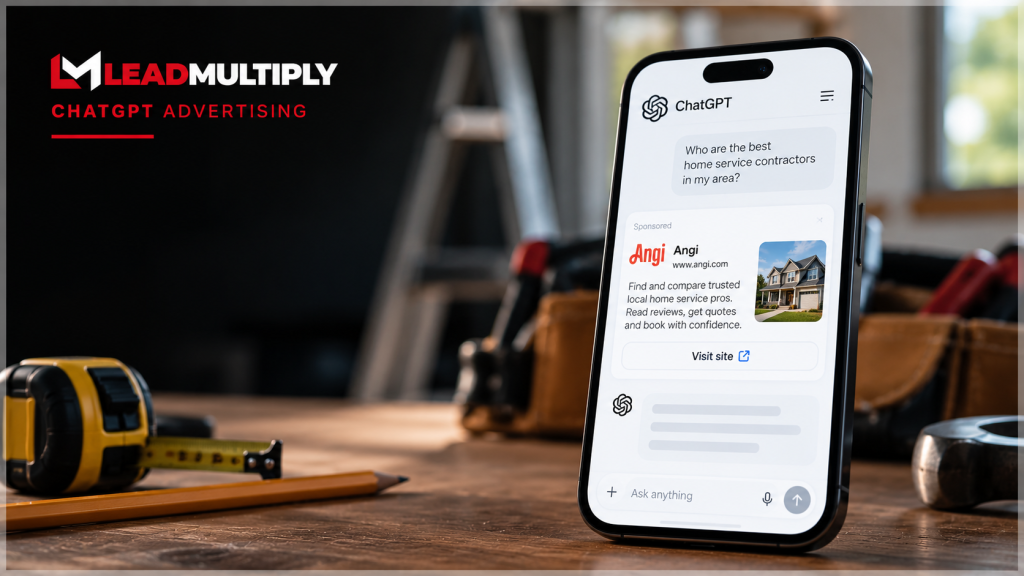
For home service companies, one of the more interesting early tests of ChatGPT advertising isn’t coming from a software company or an ecommerce brand. It’s coming from Angi, a business built around connecting homeowners with local professionals for repairs, maintenance, remodeling and other projects around the home.
Angi began testing ChatGPT Ads across roughly 20 home-service categories, including roofing, handyman and HVAC. As the advertising system added more campaign controls, Angi expanded its activity into nearly 30 additional categories. The company now reports that its cost per lead has fallen 34% since launching conversion-optimized campaigns, while return on ad spend improved by more than 38% from the second quarter to the third.
Those numbers are Angi’s results, not a benchmark for what an individual contractor should expect. But the test is significant for another reason. It provides an early indication that ChatGPT can become a customer acquisition channel in an industry where the path to a sale often begins with a homeowner trying to figure out what is wrong, what something should cost or whether they need to hire someone at all.
The Customer May Be Looking for an Answer Before Looking for a Contractor
For years, paid search has been built around capturing homeowners after they express their need in relatively direct terms. Someone searches for “AC repair near me,” “roofing company Phoenix” or “emergency plumber,” and contractors compete to appear in front of that customer.
ChatGPT introduces another point in that process.
A homeowner with an air conditioner that isn’t cooling properly may not begin by asking for an HVAC company. They may ask why their AC is running but the house isn’t getting cold. Someone who finds a water stain on a ceiling may want to know whether it could be a roof leak, a plumbing problem or condensation. A homeowner considering a bathroom remodel may spend considerable time asking about costs, materials and project scope before deciding which contractors to contact.
Those conversations can reveal commercial intent even when the homeowner hasn’t reached the point of explicitly searching for a company. That is particularly relevant to home services because many buying decisions begin with a problem rather than a product. The homeowner knows what is happening in the house. They don’t necessarily know what service they need, how serious the problem is or who should handle it.
Angi Is Trying to Reach Homeowners While That Decision Is Taking Shape
Angi describes its ChatGPT strategy as a way to reach homeowners while they are researching, problem-solving or deciding whether professional help is necessary. The company says that in-conversation intent has become a complement to its traditional paid-search activity rather than simply another version of it.
That distinction matters for an HVAC contractor, roofer, plumber or remodeling company evaluating the channel.
Consider a homeowner asking whether a 15-year-old air conditioner should be repaired or replaced. The eventual transaction could be a new HVAC system, but the conversation doesn’t necessarily begin with “HVAC installation company.” A roofing customer might start by asking whether hail damage requires a complete roof replacement. A plumbing customer could begin with questions about low water pressure before knowing whether there is a repair worth scheduling.
In each case, the potential customer is already working through a buying decision. The service provider that can become relevant during that process may have an opportunity to reach the homeowner before the conventional contractor search begins.
The Angi Results Also Show That Campaign Setup Matters
Angi did not report a single test followed by an immediate 34% reduction in lead cost. Its campaigns evolved as OpenAI added additional advertising capabilities.
The company began with a relatively simple category-based test. As Ads Manager developed, Angi incorporated daily budgets, CPC bidding and eventually conversion-optimized campaigns. Angi attributes the reduction in cost per lead to the period following the introduction of conversion optimization, and the stronger performance gave it enough confidence to expand into additional home-service categories.
That progression is important because it separates the opportunity from the novelty of simply placing an ad in ChatGPT. A local service company ultimately needs booked calls, appointments, estimates and customers. Traffic by itself isn’t the objective. As ChatGPT advertising develops, the ability to connect campaigns with those downstream actions will be critical to determining whether the channel deserves a larger share of a company’s customer acquisition budget.
Home Service Companies Should Think Beyond Their Search Keywords
One of the biggest adjustments for service businesses may be how they think about customer intent.
A roofing company’s Google Ads account may contain keywords for roof repair, roof replacement, storm damage and roofing contractors. Those terms remain useful because they capture people who already know what they are looking for.
ChatGPT conversations can begin considerably earlier and contain considerably more context. The same roofing company could potentially be relevant to conversations about the age of a roof, missing shingles after a storm, unexplained ceiling stains, repair versus replacement, insurance questions or the expected cost of different roofing materials. An HVAC company could encounter conversations about uneven temperatures, unusually high electric bills, heat pumps, system lifespan or an AC unit that repeatedly cycles on and off.
The advertising opportunity is therefore broader than identifying another collection of keywords. Service companies need to understand the questions, symptoms, decisions and situations that eventually produce their customers.
Paid Search Isn’t Going Away
Angi’s experience doesn’t suggest that home service companies should abandon Google Ads and move their budgets to ChatGPT. Angi itself describes ChatGPT Ads as complementary to traditional paid search.
The two channels can reach customers at different points in the same decision. Search remains extremely valuable when someone knows what they need and actively looks for a provider. ChatGPT can potentially reach that person while the need is still being defined. For businesses where a new customer can be worth hundreds, thousands or tens of thousands of dollars, gaining access to that earlier stage of the decision could become meaningful.
The question for service companies isn’t whether ChatGPT will replace Google. It’s whether some portion of their future customers will begin their buying process in an AI conversation rather than a search box.
Angi’s early results provide one of the first pieces of evidence that, in home services, some already are.