
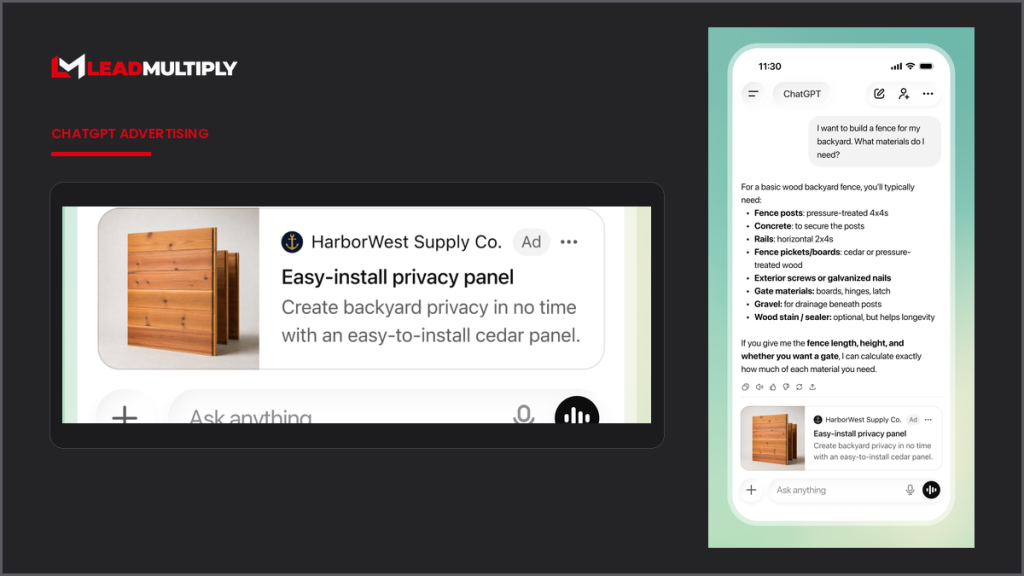
Every major digital advertising channel connects businesses with customers differently. Google Ads responds primarily to the words people type when they are actively searching for something. Meta uses audiences, interests and behaviors to reach people before they necessarily begin searching. ChatGPT Ads introduces another model, and treating it like either of those channels misses what makes it different.
The fundamental difference is that ChatGPT advertising begins with a conversation. A person may have already expressed exactly what they want, or they may have spent several exchanges discussing a problem, comparing possibilities, establishing constraints or working toward a decision. OpenAI explains that ChatGPT Ads considers the context of the current conversation when determining which ads are relevant. For a business, that changes more than where its advertising appears. It changes how and when the business can become relevant to a customer.
The Customer Doesn’t Have to Start With a Search
Search advertising became enormously effective because the search itself can reveal intent. Someone searching for an emergency plumber, business attorney or new accounting software has communicated quite a bit in a handful of words. A business can advertise against those searches because the customer is directly declaring what they want.
That can happen in ChatGPT too. Someone can explicitly ask for help finding a particular product, service or business. But the advertising opportunity isn’t limited to conversations that begin that way. Someone could start by trying to understand a problem, continue by exploring possible solutions and eventually provide enough context for a particular product or service to become relevant. OpenAI describes ChatGPT Ads as an opportunity to reach people as they explore options, compare alternatives, weigh tradeoffs and make decisions.
This creates opportunities that may not begin with an obvious request for a business or service. A customer could enter a conversation with a problem rather than a product in mind, then discover through that conversation what kind of solution is appropriate. To advertise effectively in ChatGPT, a business needs to understand the different situations in which its product or service could become relevant, including situations where buying intent develops gradually.
Context Hints Are Not Keywords With a Different Name
Context hints are one of the inputs businesses provide when advertising in ChatGPT, but they are not a new version of keywords. OpenAI’s guidance on context hints specifically states that they are not exact-match keywords or targeting rules. They provide additional information that helps its system understand what an advertiser offers, who it helps and the situations or decisions in which that offering may be useful.
This matters because a customer does not have to use the same words contained in a context hint. What matters is whether the need, situation or decision developing in the conversation makes the business relevant. A roofing company, for example, may become relevant during a conversation about storm damage, insurance questions, recurring leaks or whether a roof should be repaired or replaced, even when the customer did not begin by searching for a roofer.
This is why our work starts with what we call Conversation Intent Mapping. We research the different ways someone could become a customer, including direct situations where the person is already looking for what the business provides and less obvious situations where the commercial opportunity develops through the conversation. We then use that research to build the campaign around actual customer needs and circumstances rather than simply turning an existing keyword list into longer phrases.
The Landing Page Has a Different Job
Landing pages have always mattered in digital advertising, but they have an additional role in ChatGPT Ads. The information available through an advertiser’s landing page helps provide context about the business and its offering. OpenAI also requires ad landing pages to be accessible to its advertising crawler.
A generic landing page may not adequately support every situation in which a business could become relevant. Someone comparing several known providers may need different information from someone who has only recently identified the type of solution they need. If those customer situations are materially different, the advertising and the pages customers reach may need to address those differences.
OpenAI’s ad-group guidance recommends separating meaningfully different use cases when they require different messaging or landing pages. That makes the landing page part of how the advertising system understands the offer as well as the place where a prospective customer decides whether to take the next step.
More Ads Doesn’t Mean More Versions of the Same Ad
OpenAI recommends using multiple ads within an ad group to test different approaches to the same theme and separating meaningfully different use cases when they require different messaging or landing pages.
For a business, this does not mean producing dozens of superficial variations of the same advertisement. Two customers can ultimately need the same service for very different reasons. Advertising that reflects those different situations can be more useful and relevant than repeatedly changing a headline while leaving the underlying message unchanged.
The objective is to cover the meaningful ways the business can become relevant to a prospective customer. Understanding those situations gives the campaign a stronger foundation and allows the advertising, supporting information and landing pages to address what different customers are actually trying to accomplish.
We Don’t See the Conversation
There is another important distinction, both strategically and from a privacy standpoint. Advertisers do not get access to people’s private ChatGPT conversations. OpenAI’s advertising principles state that conversations are kept private from advertisers and that user data is not sold to advertisers.
LeadMultiply does not inspect private conversations or identify prospective customers inside them. We study the business, its customers and the situations that could create commercial opportunities. We use that research to develop the campaign information, advertising and landing pages. ChatGPT then uses the information available to its advertising system to determine which ads are relevant.
That separation is fundamental to understanding how the model works. We can map the situations in which someone could become a customer, but we are not sitting inside a live conversation identifying that person ourselves. ChatGPT has the conversational context. The advertiser provides information that helps its advertising system understand where the business fits.
Measurement Still Matters, but the Inputs Are Changing
Not everything about digital advertising has been reinvented. A business still needs to know whether its advertising produces results. OpenAI has introduced CPC bidding, pixel-based measurement and a Conversions API that can measure actions including purchases, leads and sign-ups. OpenAI’s announcement of expanded ChatGPT Ads measurement explains how those tools are being used to measure outcomes while keeping individual conversations private.
The difference is in what contributes to those results. ChatGPT advertising adds conversation context, customer situations and context hints to familiar elements such as the advertisement, landing page, budget and conversion data. A campaign therefore has to do more than appear in ChatGPT. It must connect the right business with a relevant customer situation and give that customer a clear reason to take the next step.
As campaign and conversion data accumulates, we can determine which customer situations produce business, where the original research was accurate, where opportunities were missed and where the campaign needs to change. The technology is new, but the standard should remain familiar to any business owner: measure whether the advertising produces customers and use that information to improve it.
What This Means for Businesses
OpenAI’s Ads Manager documentation shows familiar campaign components, including campaigns, ad groups, objectives, budgets, context hints and individual ads. That familiar structure can make ChatGPT advertising look more like established advertising channels than it really is.
Google Ads gives businesses a way to respond when someone declares what they want through a search. Meta gives businesses ways to reach people based on who they are and what may interest them. ChatGPT adds the context of an ongoing conversation, including what someone is exploring, comparing, considering and trying to accomplish. That context can allow a business to become relevant before the customer would have known what to search for.
A business cannot simply transfer its Google Ads or Meta Ads strategy into ChatGPT and expect the same result. An effective campaign has to account for the questions customers ask, the problems they are trying to solve and the context that develops before an ad appears. That is the real shift: advertising in ChatGPT must be built around how customers make decisions in a conversation.
See How ChatGPT Advertising Works for Your Business
Learn how we research customer demand, build and manage campaigns, develop the ads and landing pages, and measure whether the advertising produces customers.
Explore ChatGPT Advertising →